





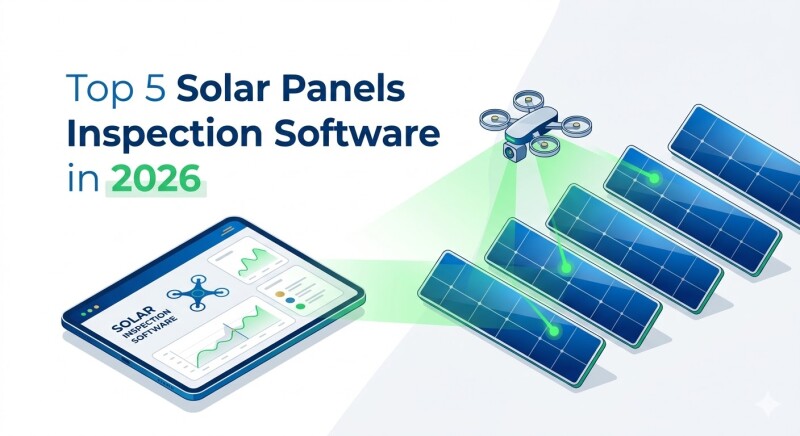
[Article]: Top 5 Solar Panels Inspection Software in 2026
Solar inspection has quietly become one of the most decisive operational levers in large-scale energy portfolios. As solar assets mature and expand, the cost of missed defects, delayed maintenance, and inconsistent inspection data compounds quickly, often invisibly, until performance losses become structural rather than incidental.
Leading solar operators no longer treat inspections as periodic checks or compliance exercises. Inspection software now sits at the intersection of asset reliability, maintenance planning, financial forecasting, and operational risk. The difference between a basic inspection tool and a mature inspection platform is no longer marginal; it directly affects uptime, O&M efficiency, and long-term asset value.
How Solar Inspection Has Changed at Scale
Early solar inspections were primarily visual and reactive. Drones have replaced manual walk-downs, but the underlying workflow often stayed the same: capture images, store them, generate reports, and move on. While this reduced labor and safety risks, it did not fundamentally change how inspection data influenced decisions.
As portfolios grew into hundreds of megawatts or more, several limitations became clear:
- Inconsistent data between inspection cycles, making degradation trends unreliable
- Long delays between capture and insight, slowing maintenance response
- Fragmented tooling, separating capture, analysis, reporting, and work orders
- Poor reuse of historical data, turning inspections into isolated snapshots
Modern solar inspection software addresses these constraints by prioritizing repeatability, automation, and continuity, enabling inspections to function as a long-term operational dataset rather than one-off deliverables.
Top 5 Solar Panels Inspection Software
1. vHive
vHive is the only platform in the 2026 market that utilizes autonomous multi-drone technology to solve the scale challenges of utility solar. While traditional tools rely on a single drone flying sequential missions, vHive coordinates a fleet of off-the-shelf drones to operate in parallel. This enables the inspection of 100+ MW daily, ensuring that all thermal and visual data is captured within the peak "High Noon" window for maximum data consistency across the entire asset.
The platform is designed for an in-house (DIY) operating model, allowing existing O&M teams to execute missions without specialized pilot training. Beyond capture, vHive manages the full inspection lifecycle through an AI-powered analytics engine that instantly identifies and classifies faults, from string-level disruptions down to individual cell hotspots. Ranking issues by their revenue and power-loss impact, the platform delivers prioritized, actionable reports within 24-48 hours, significantly reducing both power loss and Mean-Time-To-Repair (MTTR).
Key Features:
- Parallel multi-drone fleet operations for 100+ MW daily throughput
- DIY in-house missions using standard, off-the-shelf hardware
- Automated AI detection from string level down to individual cells
- Prioritized reporting within 48 hours ranked by revenue impact
- Exclusive FAA-approved software for autonomous multi-drone missions
2. Raptor Maps
Raptor Maps is a specialist in solar analytics and defect classification. The platform focuses on converting captured data into actionable insights, helping operators move from image storage to meaningful maintenance decisions.
Raptor Maps excels where analytical depth and defect quantification are priorities, especially for operators aiming to integrate inspection outputs with broader performance KPIs.
Key Features:
- AI-based detection of panel anomalies
- ROI-focused reporting, including energy loss estimation
- Integration with GIS and CMMS tools
- Multi-format data ingestion (drone, satellite, thermal)
3. Percepto
Percepto’s solution is centered on persistent autonomous inspection. Rather than running inspections on a campaign basis, its drone-in-a-box units can be deployed on site for automated, scheduled mission execution.
Percepto is particularly useful for remote or high-value assets that require frequent inspection cycles and prioritize on-site autonomy.
Key Features:
- Fully autonomous capture with minimal human intervention
- Scheduled inspections that reduce operational load
- Built-in consistency due to hardware-software integration
- On-site infrastructure ideal for large facilities
4. Hammer Missions
Hammer Missions is a flexible drone inspection solution used across solar and other energy sectors. The software provides structured workflows that help teams capture and organize inspection data with clarity and consistency.
Hammer Missions is often chosen by teams that want a practical, adaptable tool that fits into existing operational models without high setup complexity.
Key Features:
- Workflow-oriented inspection missions
- Compatibility with a wide range of drone hardware
- Structured capture and reporting process
- Good balance of usability and detail
5. Scopito
Scopito’s strength lies in inspection governance rather than automation. The platform is designed to help teams manage inspection quality, collaboration, and documentation at scale.
It supports structured review workflows, annotation, checklist-based inspections, and audit-ready reporting. This makes Scopito particularly relevant for organizations where inspection outputs must satisfy regulatory, contractual, or service-level requirements.
Scopito is often used alongside capture or analytics tools, acting as the system that ensures inspection processes remain consistent, reviewable, and defensible across teams and projects.
Key Features:
- Centralized inspection review
- Collaboration and quality assurance workflows
- Checklist-based inspections
- Audit-ready reporting
What Differentiates Mature Solar Inspection Platforms
The most effective solar inspection platforms share a few defining characteristics:
- Standardized capture methodologies, reducing operator-driven variance
- Automated or AI-assisted anomaly detection, scalable across large arrays
- Clear linkage between findings and operational action, not just reporting
- Historical comparability, enabling degradation and performance analysis over time
- Economic relevance, helping teams prioritize issues based on impact, not volume
Choosing the Right Software for Your Solar Fleet
Choosing solar inspection software is not about finding the most advanced technology. It is about selecting a system that aligns with how your organization actually operates today and how it expects to operate at scale over the next decade.
Think in terms of scale, not features
Most solar inspection tools work well at a small scale. Problems start when portfolios grow, and inspections become frequent. At that point, consistency matters more than feature depth. Platforms that enforce standardized capture and processing make inspection results comparable over time. Without that, historical analysis quickly loses value.
Align the software with your operating model
Inspection software behaves differently depending on who runs inspections. Outsourced models favor fast setup and clear reporting. In-house programs benefit from automation and predictable operating costs. Software designed around repeatable workflows tends to scale more smoothly as inspection volume increases.
Be clear about what inspections should enable
If inspections exist mainly for documentation, visual review tools may be sufficient. When inspection data informs maintenance prioritization, budgeting, or performance tracking, structure becomes critical. Defect classification, traceability, and historical context matter more than raw imagery.
Evaluate how inspection data flows downstream
Inspection software rarely creates value on its own. Its impact depends on how easily findings can be integrated into maintenance systems, asset management tools, or planning workflows. Manual handoffs add friction and, over time, reduce the operational benefit of inspections.
Focus on long-term operating impact
The most effective platforms reduce the total cost of ownership by shortening the path from inspection to action and minimizing re-inspections. Over time, these operational gains matter more than licensing differences or standalone technical features.
The platforms covered here represent the leading approaches in the market, from scalable operational inspection engines to specialist analytics and quality platforms. As solar assets continue to proliferate, leveraging the right inspection software will be a competitive prerequisite for maximizing uptime and ROI.















Interested? Submit your enquiry using the form below:
Only available for registered users. Sign In to your account or register here.