



Throughput vs Stability: How to Tune the Cell
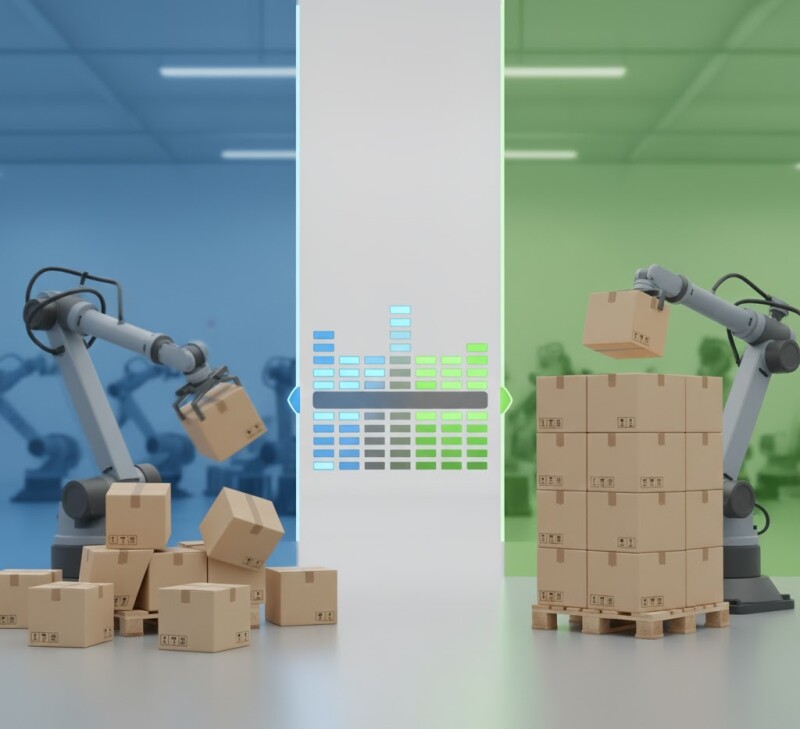
In palletizing, faster is not always better. Push throughput too hard, and box deformation, slippage, or unstable stacks can turn automation into chaos. The key is to find the right balance between cycle rate and mechanical stability.
The Trade-Off Curve
Every palletizing system has a performance envelope defined by robot acceleration, gripper force, and product integrity. Running at 95% of theoretical speed often delivers higher uptime than chasing maximum cycles per hour.
Tuning Parameters That Matter
- Acceleration/Deceleration: Reduce jerk to prevent box sliding.
- Approach angles: Optimize pick and place to minimize lateral forces.
- Vacuum hold time: Increase dwell on heavy or porous loads.
- Dynamic payload adjustment: Use sensors to detect stack offset in real time.
Monitoring and Feedback
Install IMU sensors or cameras to track stack motion during cycle acceleration. Feed that data into AI tuning models that adjust speed on the fly — a feature increasingly built into modern cobot controllers.
Example
A packaging plant improved throughput by 12% after retuning jerk profiles and implementing load monitoring. Stack stability increased 30%, reducing pallet collapse events to zero.
Related Articles
- Mixed-Case Palletizing: Vision and Path Planning
- Slip Sheets, Stretch Wrap, and End-Effectors
- Retrofit Guide: Upgrading Old Palletizers with Vision
Conclusion
Smart tuning is what separates a good palletizer from a great one. By balancing speed and stability — and using feedback to adapt — manufacturers can achieve reliable, round-the-clock performance.















Interested? Submit your enquiry using the form below:
Only available for registered users. Sign In to your account or register here.