





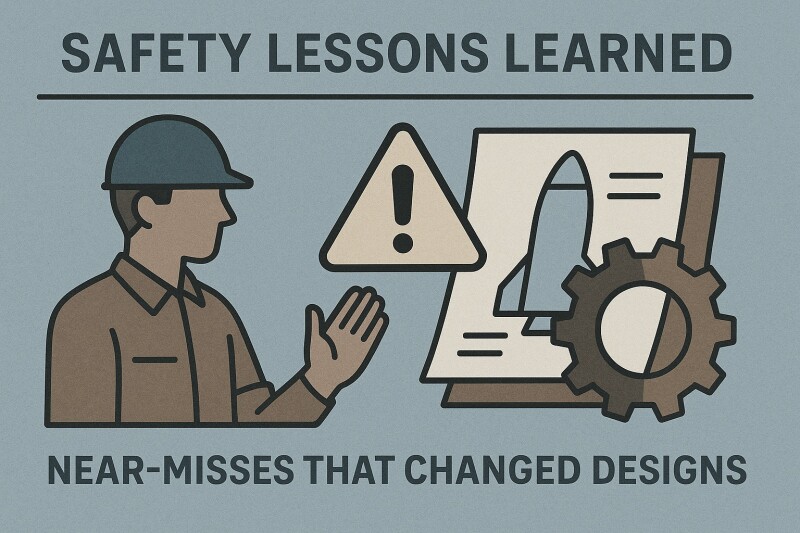
Safety Lessons Learned: Near-Misses That Changed Designs
Every successful HRC deployment includes lessons learned the hard way. Near-misses — minor contact, unexpected stops, or misaligned safety zones — drive continuous improvement in both hardware and process design.
Common HRC Safety Near-Misses
- Unexpected robot motion: Faulty recovery logic triggered unintended joint movement.
- Incorrect safety field tuning: Misconfigured scanners led to zone overlap and delayed stops.
- Tool inertia: Light contact thresholds misjudged when tool weight was underestimated.
Design Improvements That Followed
- Dynamic speed and separation monitoring (DSSM) implemented using real-time tracking.
- Safety PLC interlocks between cobots and conveyors.
- Comprehensive re-validation under ISO/TS 15066 contact force limits.
Case Example: Automotive Assembly Cell
After a near-miss caused by visual obstruction, engineers redesigned the layout to ensure 1.6 m of safe approach distance and added soft covers to the gripper. No further events occurred after 10,000 collaborative cycles.
Related Articles
- 10 Real HRC Applications: Assembly, Screwdriving, and Testing
- Ergonomics Wins: How Cobots Reduce Injuries and Absence
- From Prototype to 24/7: Making HRC Reliable
Conclusion
Safety maturity comes from transparency. Sharing near-misses — and the design corrections that followed — ensures that each new HRC project starts stronger than the last.














Interested? Submit your enquiry using the form below:
Only available for registered users. Sign In to your account or register here.