




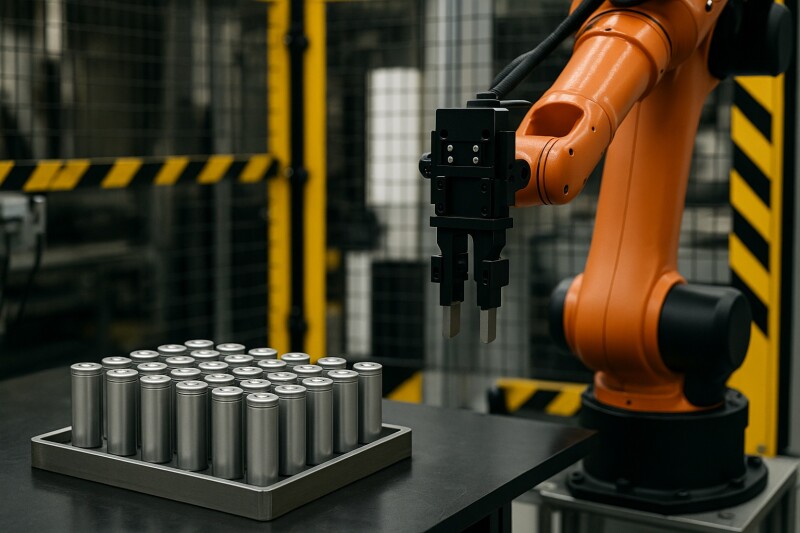
Robots in Battery Assembly: Safety and Part Handling
Battery assembly combines high weight, electrical energy, and chemical sensitivity — a perfect storm for automation design. Robots enable safe, repeatable handling but must respect electrical isolation, precision, and ergonomic standards.
Core Challenges
- Weight and geometry: Modules can exceed 100 kg with fragile connectors.
- ESD and short-circuit risk: Robots must use insulated grippers and current-limited tools.
- Thermal management: Some operations (welding, curing) emit heat that affects sensors.
Design Best Practices
- Use torque-limited collaborative robots for manual-assist zones.
- Integrate force sensing and 3D vision for connector alignment.
- Implement interlocks between charging, welding, and transfer zones.
Safety Integration
Comply with ISO 10218 and ISO/TS 15066 for collaborative zones. Combine physical barriers with safety-rated soft limits and zone monitoring.
Case Example: EV Module Line
A Tier-1 supplier automated module stacking using twin-arm robots and vacuum grippers. Operator exposure to high-voltage parts dropped 80%, while takt time improved 25%.
Related Articles
- Traceability for Cells and Packs: Data from Day One
- Quality Control for EV Batteries: From Vision to X-Ray
- OEE in Gigafactories: Where the Losses Hide
Conclusion
Robotics in battery assembly are about more than speed — they ensure safety, consistency, and compliance in one of manufacturing’s most demanding environments.














Interested? Submit your enquiry using the form below:
Only available for registered users. Sign In to your account or register here.