





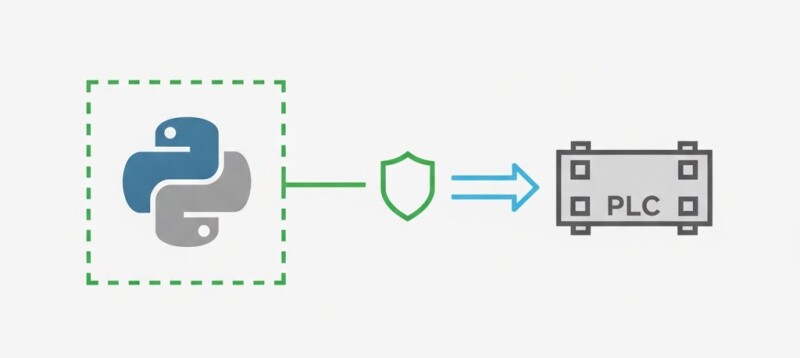
Python Next to PLCs: Safety, Sandboxing, and IPC
Python is rapidly entering the factory floor — powering analytics, dashboards, and maintenance copilots. But using it next to safety-critical PLCs requires disciplined design to avoid unintentional risk or interference.
Why Python at the Edge?
- Fast prototyping for data analysis and AI inference.
- Easy integration with MQTT, OPC UA, and REST APIs.
- Rich ecosystem of libraries for signal processing, vision, and reporting.
Safety and Isolation Principles
- Sandboxing: Run Python inside a container (Docker, Podman, or LXD) with limited privileges.
- Inter-process communication (IPC): Exchange data with PLCs using OPC UA, gRPC, or shared memory — never direct I/O access.
- Read-only mode: Python should consume and process data, not issue live control commands.
Implementation Example
A food manufacturer deployed a Python model for predictive quality, hosted in a Docker container communicating with Siemens S7 PLCs via OPC UA. Strict network segmentation ensured zero interference with control loops.
Related Articles
- Pandas + Historians: Fast Root-Cause Analysis
- Scheduling Data Jobs in OT: Cron, MQTT, and Triggers
- When to Keep Python Off the Line: Risk-Based Rules
Conclusion
Python belongs in OT — but only inside clear boundaries. With sandboxing, containerization, and read-only data access, it becomes a safe, powerful companion to deterministic PLC logic.














Interested? Submit your enquiry using the form below:
Only available for registered users. Sign In to your account or register here.