



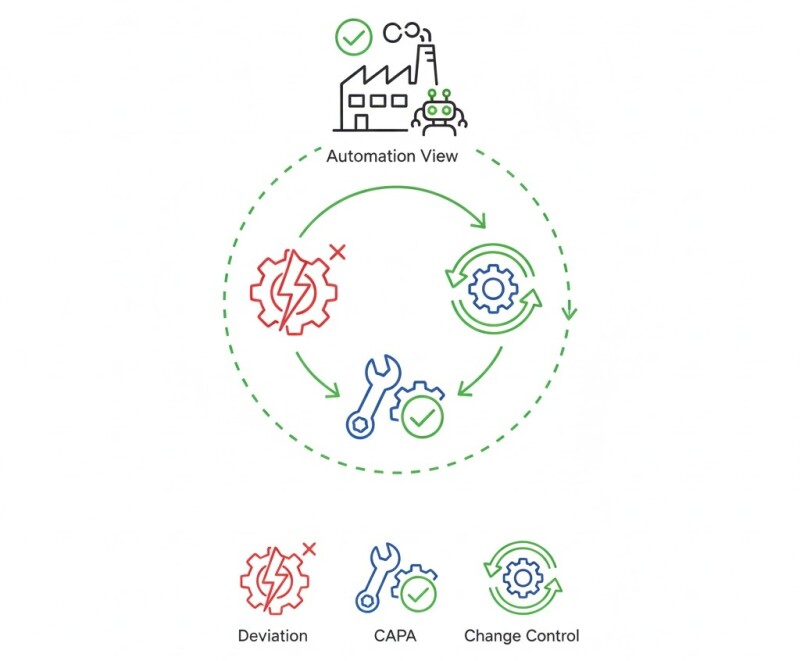
Deviation, CAPA, and Change Control: An Automation View
Every GMP-compliant plant depends on robust systems for Deviation Management, Corrective and Preventive Actions (CAPA), and Change Control. For automation engineers, these processes ensure traceability, safety, and validation integrity across all software and hardware modifications.
Automation’s Role in CAPA
Automation is often both the cause and solution of deviations. A minor PLC code update can trigger process alarms, while a simple control improvement can eliminate recurring CAPAs entirely.
Best Practices
- Implement electronic change control with unique IDs, reasons, and signatures.
- Link change requests to validation protocols (IQ/OQ/PQ) and risk assessments.
- Use MES or QMS integration to automatically trigger CAPA workflows when deviations exceed thresholds.
Automation-Specific Risks
- Unauthorized software updates or parameter changes.
- Untracked firmware revisions or network configuration shifts.
- Script reuse across validated and non-validated environments.
Case Example: Biopharma Plant Upgrade
During a PLC migration, automated change tracking and deviation logging reduced audit findings to zero. CAPA cycle times improved by 40%, and validation rework costs fell dramatically.
Related Articles
- CSV and 21 CFR Part 11 for Automation Engineers
- Audit-Ready eSignatures and eRecords in the Plant
- Batch Records That Pass: eBR/eDHR Design Patterns
Conclusion
Automation and quality must move together. With digital CAPA, real-time deviation tracking, and controlled change workflows, plants ensure that every improvement remains compliant — and every audit, successful.












Interested? Submit your enquiry using the form below:
Only available for registered users. Sign In to your account or register here.