





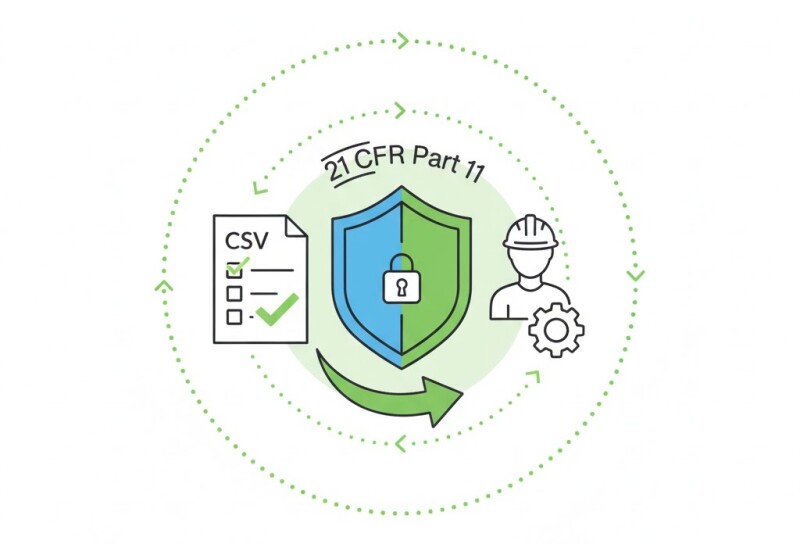
CSV and 21 CFR Part 11 for Automation Engineers
Computer System Validation (CSV) is at the core of pharmaceutical and biotech automation. For engineers, understanding 21 CFR Part 11 — and how it applies to PLCs, SCADA, MES, and data systems — ensures compliance without stalling innovation.
What CSV Really Means
CSV isn’t just documentation; it’s proof that a system consistently performs as intended. It covers everything from automation software to data storage and audit trails.
Key Validation Steps
- URS (User Requirements Specification): Defines what the system must do — traceable to every test.
- DQ, IQ, OQ, PQ: Qualification stages validating design, installation, operation, and performance.
- Change Control: Every update to logic, firmware, or scripts must be version-controlled and revalidated.
21 CFR Part 11 in Practice
- Audit trails must record who, what, when, and why.
- Electronic signatures must be linked to verified user credentials.
- Records must be secure, tamper-evident, and retrievable for 10+ years.
Case Example: SCADA Upgrade in Biotech
A biotech facility upgraded its SCADA system and integrated electronic audit trails into each recipe change. Validation effort dropped 30% thanks to templated protocols and modular IQ/OQ libraries.
Related Articles
- Audit-Ready eSignatures and eRecords in the Plant
- Batch Records That Pass: eBR/eDHR Design Patterns
- GAMP 5 and AI: Validating Models in Regulated Environments
Conclusion
Validation is a mindset, not a barrier. For automation engineers, mastering CSV and Part 11 compliance builds trust — between process data, regulators, and digital transformation.













Interested? Submit your enquiry using the form below:
Only available for registered users. Sign In to your account or register here.