




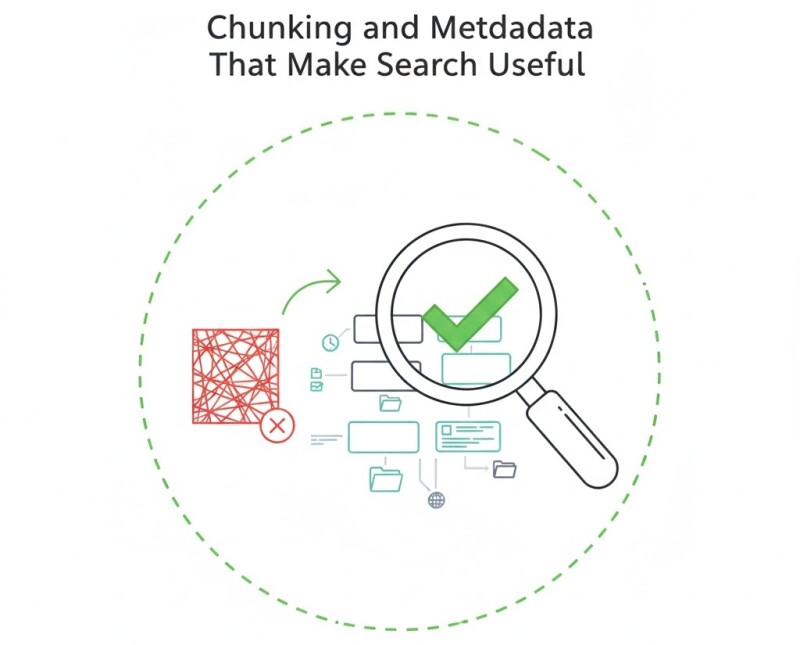
Chunking and Metadata That Make Search Useful
In Retrieval-Augmented Generation (RAG) systems, chunking — dividing documents into searchable pieces — is the foundation of precision. Done poorly, copilots return irrelevant or truncated answers. Done right, they deliver operator-level context in milliseconds.
Choosing the Right Chunk Size
- Short chunks (100–200 words): Good for targeted answers but risk missing context.
- Long chunks (400–800 words): Preserve intent but may dilute search accuracy.
- Hybrid: Include both chunk and section-level embeddings for flexibility.
Metadata That Matters
- Machine ID or asset name
- Process step or line section
- Revision number and approval date
- Skill level required (operator, technician, engineer)
Indexing Strategy
Combine dense embeddings (for semantic relevance) with keyword tags (for precision filtering). This hybrid approach outperforms plain vector search by up to 30% in RAG-based copilots.
Case Example
An aerospace supplier rebuilt its document search with metadata-aware chunking. AI copilots began retrieving correct troubleshooting steps 98% of the time — up from 73% before optimization.
Related Articles
- From PDFs to Answers: Structuring SOPs for RAG
- Human-In-the-Loop QA for Technical Answers
- Measuring Copilot ROI: MTTR, First-Time Fix, and Training
Conclusion
Smart chunking and metadata tagging are what separate a chatbot from a true industrial copilot. Structure determines reliability — and reliability drives trust.













Interested? Submit your enquiry using the form below:
Only available for registered users. Sign In to your account or register here.