





From PDFs to Answers: Structuring SOPs for RAG
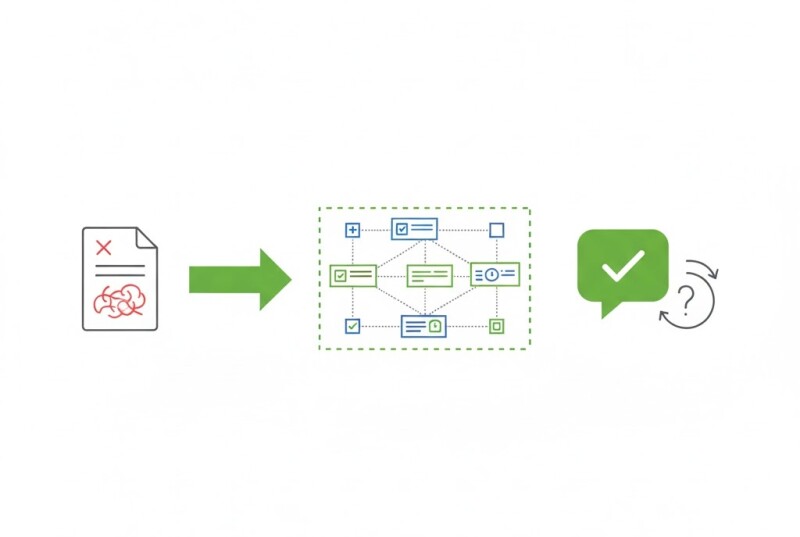
Most factories still store their Standard Operating Procedures (SOPs) in static PDFs — great for documentation, poor for AI. To enable effective Retrieval-Augmented Generation (RAG), these procedures must be structured, contextual, and machine-readable.
Why Traditional PDFs Don’t Work
LLMs can’t reason effectively over long, unstructured documents. Without clear headings, metadata, or step delineation, AI copilots often provide incomplete or incorrect responses.
Best Practices for Structuring SOPs
- Segment by intent: Break large manuals into logical, standalone tasks.
- Use consistent headings: “Objective,” “Tools,” “Steps,” and “Verification.”
- Add context tags: Machine type, system, product variant, skill level.
Conversion Workflow
- Convert PDF to text and parse hierarchy using AI-assisted extraction.
- Store chunks in a vector database with metadata (machine, process, revision).
- Embed full revision history to maintain auditability.
Case Example
A food packaging plant restructured 400 SOPs into RAG-compatible JSON documents. Maintenance copilots began answering technician queries with 94% accuracy in under 2 seconds.
Related Articles
- Chunking and Metadata That Make Search Useful
- Human-In-the-Loop QA for Technical Answers
- Safety Guardrails: When Not to Trust the Copilot
Conclusion
Structured SOPs transform static manuals into live knowledge bases. The key to RAG success lies in consistent formatting, metadata, and contextual depth — not just digitization.











Interested? Submit your enquiry using the form below:
Only available for registered users. Sign In to your account or register here.