




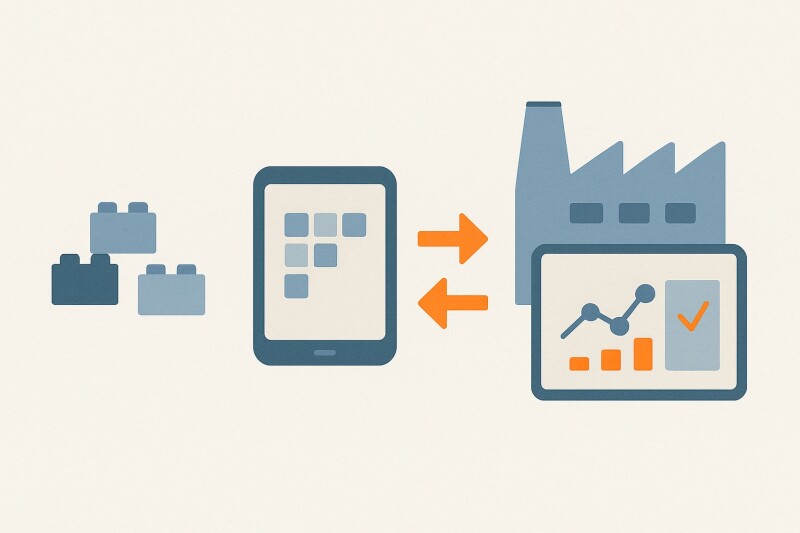
When to Graduate from No-Code to a Real MES
No-code platforms are excellent for quick wins and prototypes. But as data volume, traceability, and audit requirements grow, plants eventually need to scale up to a full MES (Manufacturing Execution System). Knowing when to make the switch avoids both over-engineering and technical debt.
Signs It’s Time to Move Beyond No-Code
- Multiple apps overlap in function or data.
- Operators manually sync or export information between systems.
- Compliance or quality audits require immutable records.
- Downtime tracking and genealogy need integration with ERP.
Typical Upgrade Path
- Consolidate existing no-code data models and naming conventions.
- Select a modular MES with open APIs (Ignition, Aveva, Siemens Opcenter).
- Integrate via OPC UA or MQTT to reuse the same data layer.
- Migrate logic incrementally — start with quality, then scheduling and traceability.
Cost and ROI
A phased MES deployment can reuse up to 60% of previous low-code work. This minimizes downtime and training costs while providing long-term scalability and cybersecurity compliance.
Case Example: Electronics SME
After two years of using low-code dashboards, a factory migrated to a hybrid MES. Data from MQTT brokers fed directly into the new system, maintaining continuity while improving audit readiness for ISO 13485 certification.
Related Articles
- From Excel Hell to MES Lite: Low-Code Patterns That Work
- Citizen Developers in OT: Guardrails to Keep You Safe
- No-Code in the Control Room: What’s Real, What’s Hype
Conclusion
No-code solutions are an essential stepping stone, not a permanent replacement. Graduating to a real MES ensures traceability, governance, and scalability — while preserving the agility that made low-code adoption successful.














Interested? Submit your enquiry using the form below:
Only available for registered users. Sign In to your account or register here.