


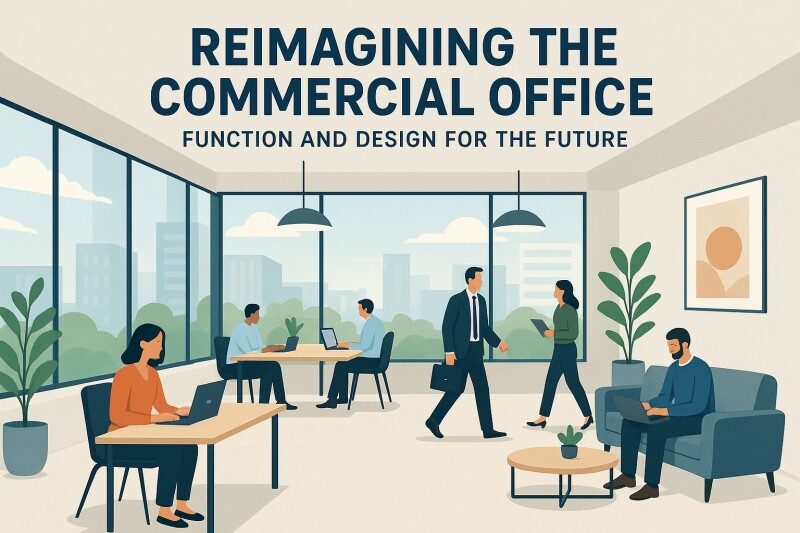
[Article]: Reimagining the Commercial Office: Function and Design for the Future
For decades, most commercial office designs utilized individual offices connected by hallways or large open office areas filled with cubicles. While these options worked well for the traditional in-person workforce, the pandemic has many property owners and facility teams reconsidering or reimagining today’s office. The old standard of having a desk and an internet connection for each employee has been replaced by a new set of office standards that now include:
- Workforce flexibility for in-person and remote employees
- Adaptable spaces that can be quickly reconfigured to meet changing business needs
- Digital technology to improve customer journeys while streamlining workflows
- Sustainable materials to meet new green building codes or LEED and WELL standards
- Employee well-being
- Reduced maintenance and repair costs
Since much of the built environment is over five years old, many existing offices were designed around old-fashioned headcounts and square footage formulas. As a result, it’s time for facility teams and property owners to reimagine existing properties to remain relevant and competitive. The framework below can assist facility teams with defining a flexible, modern, post-pandemic office space for their clients.
Facility teams and designers should assemble the workspace’s historical data, including usage, maintenance, and repair costs. These factors can establish a baseline or jumping-off point as teams collect employee feedback and suggestions for improving the workspace. The company’s future growth and expansion plans must be considered before finalizing any new layouts or design elements. Additional factors could include cross-functional collaboration between company departments, such as Human Resources (HR), Information Technology (IT), product design, marketing and branding, and real estate development.
Rethinking Office Functionality
One of the most significant changes to the modern office is that it has shifted from a place to perform work to a collaboration hub. A reimagined office space should include specific areas for Activity-Based Working (ABW) such as brainstorming, teambuilding, and project alignment activities. Utilizing task-specific areas can improve focus and collaboration while providing socialization and learning opportunities for employees and teams. When brand identity anchors become part of the new design, the office presents and reinforces the essence of its culture and values. This can increase employee buy-in while improving productivity and overall customer satisfaction.
Five Design Principles for the Modern Office
While no two companies have identical needs, the points below can be a starting point for property owners and facility teams as they reimagine an existing office space.
Technology-Enabled Efficiency
A robust and flexible cabling distribution system is essential for today’s modern office. Thanks to new technologies such as Artificial Intelligence (AI) and Virtual Reality (VR), the workstation has evolved to include physical ports including USB, Ethernet, audio jacks, and wireless connections for Wi-Fi and Bluetooth services. As a result, companies need more bandwidth than ever before, especially when the property utilizes sensors to control lighting and climate controls.
Flexibility and Modularity
The modern office design must be flexible to accommodate future staffing and workflow changes. Elements such as demountable walls and modular furniture allow any office layout to be changed quickly, without traditional construction methods, costs, and timelines.
Inclusion and Accessibility
To address the workforce's diverse needs and ADA (Americans with Disabilities Act) requirements, new layouts should incorporate universal design principles that address mobility and accessibility concerns. This can include wider doorways and walkways that allow people to easily navigate the reimagined office layout. ADA-compliant ramps should always be used to help minimize transitions for mobility-challenged visitors and employees.
Human-Centric Design
Biophilic elements that connect humans with nature can include natural light, plants, water, and natural patterns and shapes to promote employee well-being. Ergonomic furniture and options such as task lighting and adjustable desks can further reduce employee stress and fatigue.
Sustainability by Design
Between green building codes, LEED, and WELL scores, and the move to a circular economy, sustainability is another key design element of the reimagining process. Products made from recyclable materials such as steel, aluminum, and copper typically require less energy to reconfigure or refurbish, reducing environmental impact.
Additional Design Challenges and Considerations
As facility teams reimagine their clients’ workspaces, it can be challenging to balance cost and long-term value. Infrastructure elements must address today’s concerns and provide the flexibility and adaptability needed for the future. Workforce demands will continue evolving, and the office must be able to adapt to these changes quickly and efficiently or get left behind in a highly competitive market.
Offices are no longer just places where we work; they’re places where culture, innovation, and human connection happen. Facility teams should reassess their client spaces and think beyond basic office aesthetics to create impactful workspaces that promote employee collaboration and efficiency.
Flexibility across a facility or campus is critical for company success. Infrastructure elements like the Gridd® Adaptive Cabling Distribution® System can provide the data and power flexibility required for whole-building integration, essential for today’s dynamic in-person and remote end-user environments. Gridd is a raised access flooring system that relocates data and power cabling from above the ceiling to a more easily accessible space underfoot. Gridd is made from 100% U.S. Steel for superior strength, durability, and aligns with the circular economy goals to minimize waste and energy usage. Gridd requires no special fasteners or tools to install or modify which allows the system to be endlessly reconfigured to meet changing tenant needs across the building’s lifespan.
Gridd’s unique modular design and construction have remained constant over the years. Components installed today are backward compatible with those installed twenty-five years ago today, and twenty-five years from now, to maximize your ROI while reducing future upgrade costs. Gridd is a GreenSpec-listed product with approval from BuildingGreen and meets the following building standards.
- 2021, 2018, 2015, 2012, and 2009 International Building Code® (IBC)
- 2013 Abu Dhabi International Building Code (ADIBC)
- 2023 City of Los Angeles Building Code (LABC)
- 2022 California Building Code (CBC)
Please contact a Gridd Advisor to learn more about how raised access flooring can dramatically improve your office reimagining process.










Interested? Submit your enquiry using the form below:
Only available for registered users. Sign In to your account or register here.