





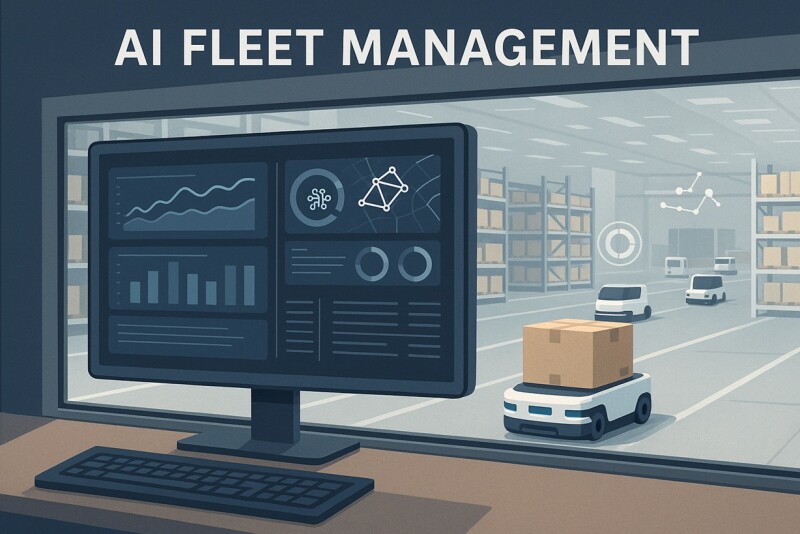
How AI Optimizes AMR Fleet Management
As intralogistics evolves toward hyper-connectivity and data-driven efficiency, AI-based fleet management is becoming the brain of modern AMR systems. Beyond simple task assignment, artificial intelligence enables predictive routing, congestion avoidance, and autonomous coordination between dozens or even hundreds of robots — without human intervention.
From Centralized Control to Distributed Intelligence
Traditional AGV systems rely on a central traffic controller that assigns tasks sequentially. This approach doesn’t scale well. As the number of robots grows, traffic conflicts and idle time increase. AI-driven fleet management replaces this model with distributed decision-making, where each AMR uses local data and Edge AI to adapt in real time.
Each vehicle becomes an intelligent node — evaluating local routes, battery level, and task priority. A central AI engine orchestrates the overall logistics flow, balancing demand, avoiding collisions, and maintaining throughput even when unexpected events occur.
Core AI Functions in Fleet Management
- Dynamic Task Allocation: Assigns deliveries based on distance, urgency, and load capacity.
- Predictive Path Planning: Uses historical data to anticipate congestion zones and reroute traffic.
- Energy Optimization: Rotates charging schedules to minimize downtime.
- Collaborative Routing: Allows multiple robots to share navigation data and improve local decisions.
These functions mirror optimization algorithms used in OEE analytics — identifying bottlenecks, prioritizing efficiency, and balancing resources dynamically.
AI Models and Data Inputs
Fleet management AI systems rely on a mix of perception and operational data, including:
- LIDAR and vision data for environment mapping
- Battery and motor temperature for predictive maintenance
- ERP/WMS integration for demand forecasting
- Traffic density and path efficiency metrics
When combined with digital twins, AI can simulate future logistics scenarios, test new routes, and validate fleet behavior before deploying changes in the real world.
Predictive Maintenance Meets Fleet Intelligence
AI doesn’t just optimize routing — it also predicts failure. By analyzing vibration, motor torque, and charge patterns, machine learning models detect anomalies before breakdowns occur. These insights tie directly into Predictive Maintenance 2025 frameworks, reducing downtime and service costs.
This continuous feedback loop — from robot to fleet to cloud — ensures operational continuity and safety, even as fleets scale to hundreds of units.
Scalability and Interoperability
Modern AI fleet platforms follow the VDA 5050 interface standard, enabling mixed fleets of AMRs from different manufacturers to cooperate. The AI engine translates each robot’s communication protocol into a unified task model, ensuring interoperability.
This modular, vendor-neutral design echoes the approach used in OPC UA over TSN, ensuring deterministic communication without vendor lock-in — a key step toward fully autonomous logistics ecosystems.
Case Study: Adaptive Routing in a Multi-AMR Warehouse
In a 2024 electronics warehouse, an AI fleet system reduced robot idle time by 22% by reassigning tasks dynamically based on camera-detected congestion. Integration with a cloud-based AI analytics platform allowed operators to visualize route heatmaps and make long-term layout improvements.
Related Articles
- AMR vs AGV in 2025: What’s the Real Difference for Smart Intralogistics?
- Warehouse Safety for AMRs: Sensors, Vision, and AI
- Intralogistics Automation ROI: Calculating the Payback of AMRs
- From Simulation to Deployment: How to Test AMR Routes
- OPC UA over TSN Explained: Determinism Without Vendor Lock-In
- OEE Analytics and Performance: How to Measure and Improve Production Efficiency
- Predictive Maintenance 2025: Sensors, Signals, and Real ROI
Quick Q&A
Q: Can AI manage fleets from different robot brands?
A: Yes — if the platform supports open protocols like VDA 5050, which allow interoperability between vendors.
Q: How does AI improve throughput?
A: By optimizing routes, avoiding congestion, and prioritizing tasks dynamically based on fleet status and demand.
Q: Is cloud or edge AI better for AMRs?
A: Edge AI provides faster decisions and resilience; cloud AI offers long-term analytics and global optimization. The best systems combine both.
Conclusion
AI turns AMR fleets from automated transporters into autonomous collaborators. By merging predictive analytics, digital twins, and open communication standards, companies achieve scalable, intelligent intralogistics that continuously learns and improves — the true hallmark of smart factories in 2025.










Interested? Submit your enquiry using the form below:
Only available for registered users. Sign In to your account or register here.