


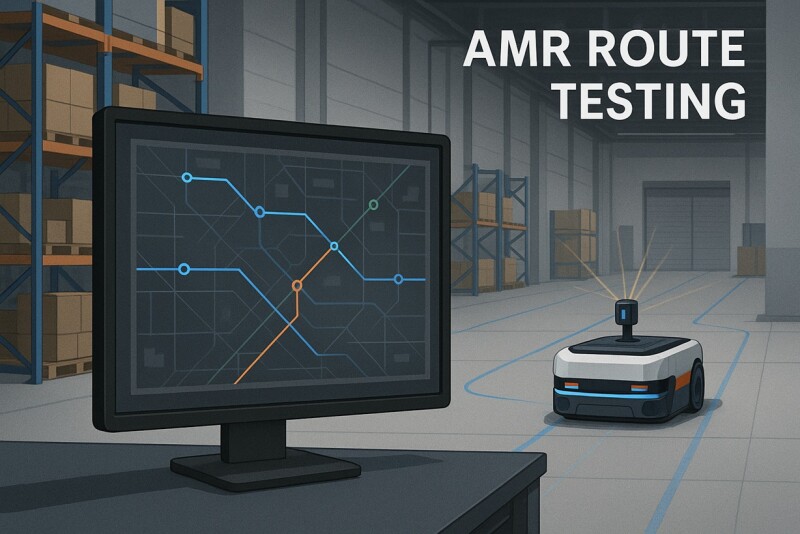
From Simulation to Deployment: How to Test AMR Routes
Before an Autonomous Mobile Robot (AMR) can operate safely in a live warehouse, it must first prove itself in simulation. Modern AMR projects rely on digital twins and route validation software to predict traffic, detect collisions, and optimize performance before deployment. This approach reduces downtime, ensures safety, and accelerates return on investment.
The Role of Simulation in AMR Deployment
Simulation provides a virtual replica of the warehouse, complete with racks, humans, and other moving vehicles. Engineers can visualize AMR paths, adjust speed zones, and test fleet coordination without risking physical damage or interruptions.
This mirrors practices from Digital Twins for Industrial Automation — using virtual models to optimize physical operations. In AMR contexts, these simulations test not only navigation but also task sequencing, traffic prioritization, and battery management.
Key Steps in Route Testing
- Map Generation: The AMR scans the environment using LIDAR and cameras to build an initial map.
- Simulation Setup: Engineers import that map into simulation software to create a 1:1 digital twin.
- Traffic Simulation: Multiple AMRs, humans, and forklifts are added to test dynamic interaction.
- Optimization: AI algorithms refine paths for minimum travel time and congestion avoidance.
- Validation: Safety and timing data are exported for audit and risk documentation.
Using AI for Route Optimization
AI models analyze route performance data and suggest alternative paths to reduce energy use or avoid traffic bottlenecks. The same fleet coordination principles described in AI Fleet Management apply at the simulation stage, allowing early detection of inefficiencies.
Some systems run continuous digital simulations even during live operation, creating a “shadow” environment that predicts future issues — a technique also used in Predictive Maintenance to forecast system wear.
Safety Validation and Functional Testing
Simulation alone isn’t enough. After virtual validation, AMRs must undergo physical safety tests following ISO 3691-4 and ISO/TS 15066 principles. These confirm that braking distances, obstacle detection, and fail-safe responses work as modeled.
Tools from Functional Safety (PL/SIL) frameworks are used to document test outcomes and ensure compliance with certification requirements.
Integrating Digital Twins with Real-Time Data
Once deployed, AMRs continuously send telemetry back to the simulation engine, updating the digital twin in real time. This feedback loop supports ongoing optimization and immediate testing of new layout changes or added robots.
This method reflects best practices from Edge AI in the Factory, where local intelligence ensures minimal latency between sensing and response.
Case Study: Route Testing Before Expansion
At an automotive parts warehouse in 2024, simulation-based testing prevented 15 potential collision zones before the first AMR was deployed. Post-deployment data showed 28% higher throughput than predicted, validating the simulation model’s accuracy and avoiding costly rework.
Best Practices Checklist
- Simulate both normal and worst-case traffic scenarios.
- Validate energy usage alongside route timing.
- Re-run simulations after layout changes or software updates.
- Include cybersecurity checks in the test plan.
Related Articles
- AMR vs AGV in 2025: What’s the Real Difference for Smart Intralogistics?
- How AI Optimizes AMR Fleet Management
- Warehouse Safety for AMRs: Sensors, Vision, and AI
- Intralogistics Automation ROI: Calculating the Payback of AMRs
- Digital Twins for Industrial Automation: How to Start Small and Scale Fast
- Functional Safety (PL/SIL) in Industrial Automation
Quick Q&A
Q: How accurate are AMR simulations compared to reality?
A: With high-fidelity maps and sensor data, deviations are typically under 5%, making simulations highly reliable.
Q: What’s the main benefit of pre-deployment testing?
A: It prevents layout conflicts, optimizes routes, and shortens commissioning time by up to 30%.
Q: Can simulations include human interactions?
A: Yes. Digital twins can model pedestrian behavior and safety zones to validate shared workspace safety.
Conclusion
Testing AMR routes through simulation bridges the gap between design and deployment. By validating traffic flow, safety logic, and energy consumption virtually, engineers can deploy with confidence, knowing their robots will perform as intended from day one — safely, efficiently, and predictably.








Interested? Submit your enquiry using the form below:
Only available for registered users. Sign In to your account or register here.