


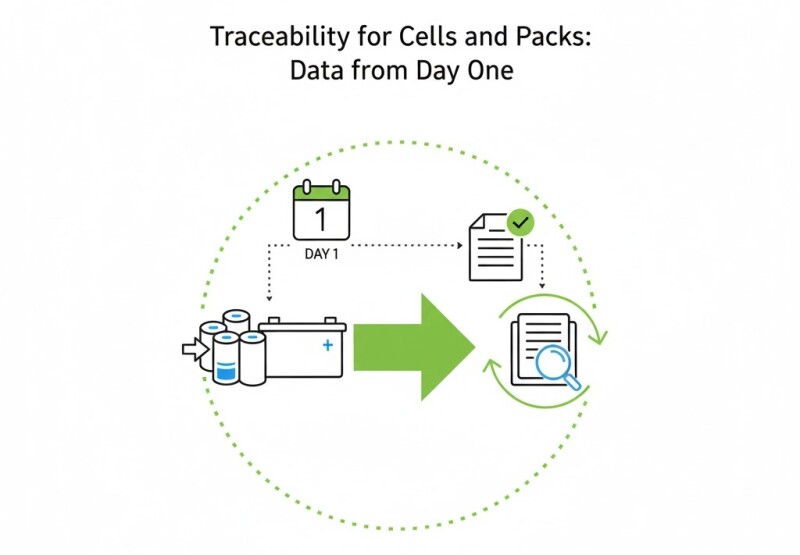
Traceability for Cells and Packs: Data from Day One
Battery manufacturers must meet growing regulatory and customer demands for full traceability — from slurry mixing to final pack assembly. End-to-end traceability is now a competitive differentiator, not just a compliance checkbox.
What Traceability Covers
- Material genealogy: Source and batch of all input materials (foil, active, electrolyte).
- Process parameters: Coating, calendaring, welding, and formation data tied to each cell ID.
- Product lineage: Mapping cells → modules → packs with unique identifiers.
Data Capture Technologies
- Laser or inkjet marking with durable 2D codes (DPMI or QR).
- Vision verification at every handoff point.
- Integration to MES or digital twin for analytics and compliance.
Benefits of “Traceability by Design”
When traceability is integrated from day one, analytics become effortless: defective packs can be traced back to electrode batches within minutes, not hours.
Case Example: EV Cell Line
An Asian battery maker used laser-coded traceability from electrode to final pack. A single SQL query now retrieves 12 process steps and 9 sensor streams per cell for warranty analysis.
Related Articles
- Automating Electrode Coating and Dry Rooms: What’s Special
- Robots in Battery Assembly: Safety and Part Handling
- OEE in Gigafactories: Where the Losses Hide
Conclusion
Traceability is the backbone of reliability. With integrated data capture and serialization, every battery tells its story — safely, transparently, and profitably.














Interested? Submit your enquiry using the form below:
Only available for registered users. Sign In to your account or register here.